
In Canada, hemp-derived CBD products face the same strict regulatory framework as marijuana-derived cannabis under the Cannabis Act. Despite widespread misconceptions, the federal government does not distinguish between CBD sources when it comes to legality. All cannabidiol products, regardless of whether they come from hemp or marijuana plants, must comply with Health Canada’s licensing requirements, product testing standards, and distribution channels through provincially authorized retailers or federally licensed online platforms. Consumers considering international retailers like the Exhale Wellness official site should know that importing CBD products remains illegal without proper Health Canada authorization.
This regulatory approach sets Canada apart from countries like the United States, where the 2018 Farm Bill created a separate legal pathway for hemp-derived CBD. Understanding the difference between hemp and marijuana matters botanically, but in Canada’s legal landscape, the source plant becomes irrelevant once CBD enters the supply chain.
The regulatory framework has sparked ongoing debate within the industry. Hemp producers argue that low-THC hemp should follow agricultural commodity rules rather than controlled substance protocols, pointing to the plant’s historical cultivation for fiber and seed. Meanwhile, Health Canada maintains that controlling all cannabinoid products through a single framework ensures consumer safety and product quality through rigorous testing requirements.
Dr. Sarah Mitchell, a regulatory consultant who has worked with over 50 cannabis license applicants, explains that many entrepreneurs underestimate the complexity. “The licensing process for hemp-derived CBD isn’t simplified just because your starting material contains minimal THC. You’re still entering the cannabis regulatory sphere with all its requirements for security clearances, facility standards, and quality assurance protocols.”
The Legal Reality: Why Hemp-Derived CBD Isn’t What You Think
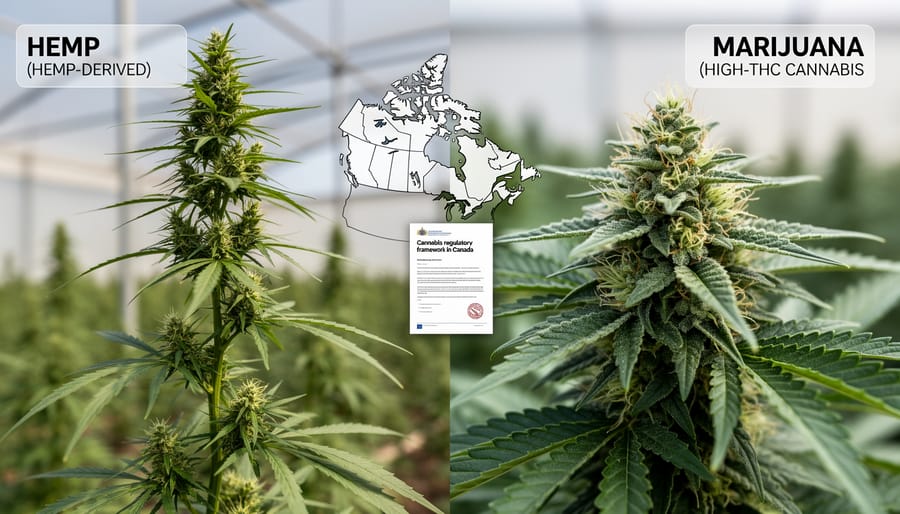
The phrase “hemp-derived CBD” carries a reassuring ring for many Canadians. It sounds agricultural, natural, perhaps even unregulated, a wellness supplement rather than cannabis. That perception, however, runs headlong into Canadian law. Under the Cannabis Act CBD products remain strictly regulated and are only legal when sold in compliance with the Act and its regulations, regardless of whether they come from industrial hemp or marijuana plants.
Here’s the confusion: hemp itself is legal to grow in Canada under industrial hemp licences, primarily for grain and fibre production. Hemp contains low levels of THC, the psychoactive compound, but can produce significant amounts of CBD. This agricultural status leads many to assume hemp-sourced CBD products slip through a regulatory gap. They don’t. The moment you extract CBD and formulate it into an oil, edible, topical, or any other product intended for human consumption, it becomes cannabis under federal law.
The distinction between hemp vs marijuana matters for cultivation rules and plant genetics, but not for the finished CBD product sitting on a shelf. Canadian regulators don’t recognize a separate category for “hemp CBD” when it comes to consumer products. Whether your CBD oil originated from a hemp field in Saskatchewan or a marijuana grow room in British Columbia, it faces identical regulatory requirements: licensed production, controlled distribution channels, standardized packaging, and restricted marketing claims.
This creates real-world consequences. You can’t legally buy CBD products from health food stores, online wellness retailers, or border shops unless they’re licensed cannabis retailers. The neighbourhood hemp store selling “CBD wellness products” operates in a legal grey zone at best, and outright violation at worst. Enforcement has been inconsistent, which feeds the misconception that these products exist in a different regulatory universe.
The source plant becomes irrelevant once CBD enters the consumer marketplace. Health Canada’s position is clear: if it contains cannabinoids and it’s for human use, it’s cannabis. That reality shapes everything from who can sell these products to how they’re labelled, tested, and taxed. Understanding this baseline removes the mystery around why hemp CBD products aren’t freely available like other supplements.
How the Cannabis Act Controls Hemp-Derived CBD in 2026
Health Canada’s Proposed Changes to Natural Health Product Regulations
In early 2026, Health Canada proposed a significant regulatory shift that could reshape how CBD products reach Canadian consumers. The agency announced plans to amend the Natural Health Products Regulations to include CBD as a recognized medicinal ingredient, potentially opening a pathway outside the current Cannabis Act framework for certain low-concentration products.
This proposed change would create what industry observers call a “dual regulatory pathway.” Under this system, CBD products meeting specific criteria could be classified and sold as natural health products rather than cannabis, bypassing licensed cannabis retailers. The move acknowledges that CBD lacks the intoxicating effects of THC and responds to years of industry pressure for more accessible distribution channels.
The proposed NHP pathway represents the most significant regulatory evolution since legalization, but compliance requirements will determine whether it truly expands market access or simply adds another layer of bureaucracy.
The practical implications remain uncertain. While the amendment could allow CBD products in health food stores and pharmacies, Health Canada has not yet specified concentration limits, testing standards, or how products would transition between regulatory frameworks. This ambiguity has created planning challenges for producers who must decide whether to pursue cannabis licensing or wait for NHP regulations to finalize.
The dual pathway also raises enforcement questions similar to those that emerged during Health Canada edibles enforcement following the 2019 rollout. Producers worry about navigating two separate compliance regimes, particularly regarding quality control, labelling differences, and ingredient sourcing documentation that varies between cannabis and natural health product standards.
For now, all CBD products remain under Cannabis Act control. The proposed NHP amendment has no implementation date, and industry stakeholders anticipate a lengthy consultation period before any changes take effect.
Labelling and Testing Standards You Need to Know

Every hemp-derived CBD product sold legally in Canada must meet strict labelling and testing standards under the Cannabis Act, regardless of whether consumers think of it as “just hemp.” Health Canada requires all cannabis product labels to display standardized health warnings, child-resistant packaging, and mandatory THC and CBD information. Unlike consumer goods in other categories, there’s no room for creative marketing claims or ambiguous ingredient lists, what appears on the label is tightly controlled.
The regulatory landscape just shifted. Licence holders can still use older labels displaying actual THC and CBD quantities or concentrations in bold, but that grace period ends until March 12, 2026. After that date, all products must comply with updated labelling requirements. Companies scrambling to redesign packaging face the same compliance pressure seen during delta-8 THC crackdowns where non-compliant inventory suddenly became unsellable.
Testing requirements don’t end at the production line. Licence holders must conduct ongoing analysis of their products to verify cannabinoid content, screen for contaminants like pesticides and heavy metals, and ensure microbiological safety. This isn’t optional quality control, it’s mandatory under federal law. Many smaller producers underestimate the cost and complexity of maintaining compliant testing protocols, especially when batch variability in hemp crops creates unpredictable cannabinoid ratios.
The bottom line: hemp-derived doesn’t mean simplified. Whether your CBD comes from industrial hemp stalks or marijuana flowers, the labelling must be identical, the testing just as rigorous, and the penalties for non-compliance equally severe.
What Science Says About Hemp-Derived vs. Marijuana-Derived CBD
The most persistent marketing myth in cannabis is that CBD extracted from hemp differs fundamentally from CBD extracted from marijuana plants. From a molecular standpoint, this claim collapses under scientific scrutiny. CBD (cannabidiol) is a single chemical compound with an identical molecular structure regardless of its botanical source. A CBD molecule extracted from industrial hemp contains the exact same atoms arranged in the exact same configuration as one extracted from high-THC cannabis.
Research published in peer-reviewed journals confirms what organic chemistry textbooks already tell us: the human body cannot distinguish between hemp-derived and marijuana-derived CBD. Once isolated and purified, the compound interacts with your endocannabinoid system in precisely the same way. The CBD molecule binds to the same receptors, triggers the same cellular responses, and produces the same physiological effects whether it originated from a hemp field in Saskatchewan or a licensed cannabis cultivation facility.
Where hemp-derived and marijuana-derived products genuinely diverge is in their complete chemical profiles. Hemp plants naturally contain minimal THC (below 0.3% by dry weight under Canadian agricultural definitions) and often lower concentrations of other cannabinoids and terpenes. Marijuana plants bred for recreational or medical use typically feature higher concentrations of THC, CBG, CBC, and diverse terpene profiles. These accompanying compounds may create what researchers call the “entourage effect,” where multiple cannabis compounds work synergistically.
This compositional difference matters for full-spectrum or broad-spectrum products, where the entire plant extract is preserved. A full-spectrum hemp extract will contain different ratios of minor cannabinoids and terpenes compared to a marijuana extract, potentially affecting overall therapeutic effects. However, if you’re using a pure CBD isolate product, the source plant is functionally irrelevant. The isolated compound performs identically.
Claims that hemp-derived CBD is “safer” or “cleaner” have no scientific foundation. Safety depends entirely on cultivation practices, extraction methods, and quality control protocols, not the plant variety. A poorly grown hemp crop can accumulate heavy metals and pesticides just as readily as marijuana. Conversely, licensed cannabis producers operating under Health Canada’s strict testing requirements produce marijuana-derived CBD that meets rigorous safety standards. The regulatory framework governing the product matters far more than the botanical classification of its source.
Cross-Border Complications: Why You Can’t Import Hemp CBD

The illegal to take cannabis across the Canadian border rule catches many travelers and online shoppers off guard, especially those who assume hemp-derived CBD operates under different laws. The Cannabis Act makes no exceptions based on source material. Whether your CBD came from industrial hemp or marijuana plants, carrying it across international borders violates federal law and can result in criminal charges, fines, and travel bans.
This prohibition applies in both directions. You can’t bring CBD products into Canada from the United States, even from states where hemp CBD is widely available in grocery stores and gas stations. Similarly, you can’t take Canadian-purchased CBD products with you when leaving the country. Border officers regularly seize products from travelers who believed the “it’s just hemp” claim would exempt them from enforcement.
Online shoppers face similar risks. Ordering CBD products from international websites and having them shipped to Canada is illegal, regardless of whether the seller advertises them as hemp-derived or compliant with their home country’s regulations. Packages crossing the border undergo inspection, and customs officials will seize any cannabis products they identify. Beyond losing your purchase, you may face legal consequences for attempting to import a controlled substance.
The confusion stems partly from hemp vape compliance and other product categories being treated differently in neighboring jurisdictions. What’s legal to purchase in Buffalo or Detroit remains prohibited the moment you cross into Ontario. Even within Canada, interprovincial travel with cannabis faces restrictions, though domestic rules differ significantly from international border laws.
What Industry Insiders Are Saying About the Regulatory Future
Industry stakeholders are watching regulatory developments with a mix of cautious optimism and practical frustration. While most acknowledge that Canada’s framework prioritizes consumer safety, many argue that the current system creates unnecessary barriers for a product derived from agricultural hemp.
Hemp producers see the proposed Natural Health Products pathway as a potential game-changer, though one fraught with uncertainty. “If CBD can be sold as an NHP alongside other supplements, it opens distribution channels that have been completely closed to us,” explains a Western Canadian hemp farmer who has watched colleagues shift away from CBD extraction entirely. “But we need clarity on timelines and transition requirements before anyone makes major investments.”
CBD manufacturers, meanwhile, navigate a complex reality where their product occupies regulatory grey space. Several mid-sized producers report spending disproportionate resources on compliance relative to larger cannabis companies that already maintain the infrastructure for licensed operations. The March 2026 labelling deadline highlighted this disparity, smaller operations scrambled to update packaging while established cannabis licensees simply adjusted existing processes.
The regulatory burden doesn’t scale with business size, and that’s pushing innovation out of Canada to jurisdictions with clearer pathways for hemp-derived products.
Regulatory consultants working with hemp businesses point to a fundamental disconnect: Health Canada treats all CBD identically regardless of source, yet industrial hemp cultivation operates under Agriculture and Agri-Food Canada with entirely different rules. This split creates confusion about which agency governs which part of the supply chain, particularly for farmers who grow hemp for fiber and seed but want to monetize CBD as a co-product.
Industry advocates are pushing for recognition that hemp-derived CBD deserves distinct consideration, not because it’s chemically different, but because it emerges from an established agricultural crop with minimal THC. They argue that risk-appropriate regulation would acknowledge this distinction while maintaining safety standards. The proposed NHP pathway represents partial acknowledgment, but advocates want clearer timelines and stronger commitment from Health Canada.
What unites these diverse voices is a shared desire for regulatory certainty. Whether the future brings dual pathways, a streamlined cannabis framework, or something entirely new, stakeholders consistently emphasize that predictable rules matter more than perfect ones. The current ambiguity costs the industry investment, innovation, and international competitiveness while consumers remain confused about what they can legally access and where.
Canada’s hemp-derived CBD landscape defies simple categorization. Whether extracted from industrial hemp or marijuana plants, CBD products operate under the same rigorous Cannabis Act framework. There’s no regulatory shortcut, no exemption based on source material. The proposed Natural Health Products Regulations amendment offers a glimpse of potential regulatory evolution, but until those changes take effect, CBD remains firmly in cannabis territory.
For consumers, this means purchasing only from licensed retailers. For producers and entrepreneurs, it means navigating federal licensing, testing protocols, and distribution restrictions regardless of your starting material. The March 12, 2026 labelling deadline marks just one milestone in an evolving regulatory environment that continues to reshape the industry.
Border restrictions remain absolute. Hemp-derived CBD carries the same legal risks as any cannabis product when crossing Canadian borders, a reality that catches many travelers and online shoppers off guard.
As Health Canada refines its approach and industry stakeholders push for clarity, staying informed isn’t optional. Regulatory frameworks will shift, compliance requirements will change, and the distinction between hemp and marijuana may eventually matter more than it does today. Until then, the law sees CBD as cannabis, full stop.